
Quick look: Dr. Christine Olmstead joins County Superintendent Dr. Stefan Bean on FutureCurrent to explain how California’s secondary redesign initiative is rethinking middle and high school experiences, promoting stronger relationships, deeper learning and more personalized instruction.
What if the first step toward redesigning middle and high school had nothing to do with changing the curriculum or rearranging the school day?
For Dr. Christine Olmstead, it starts with something more personal: knowing each student by their name, face and story.
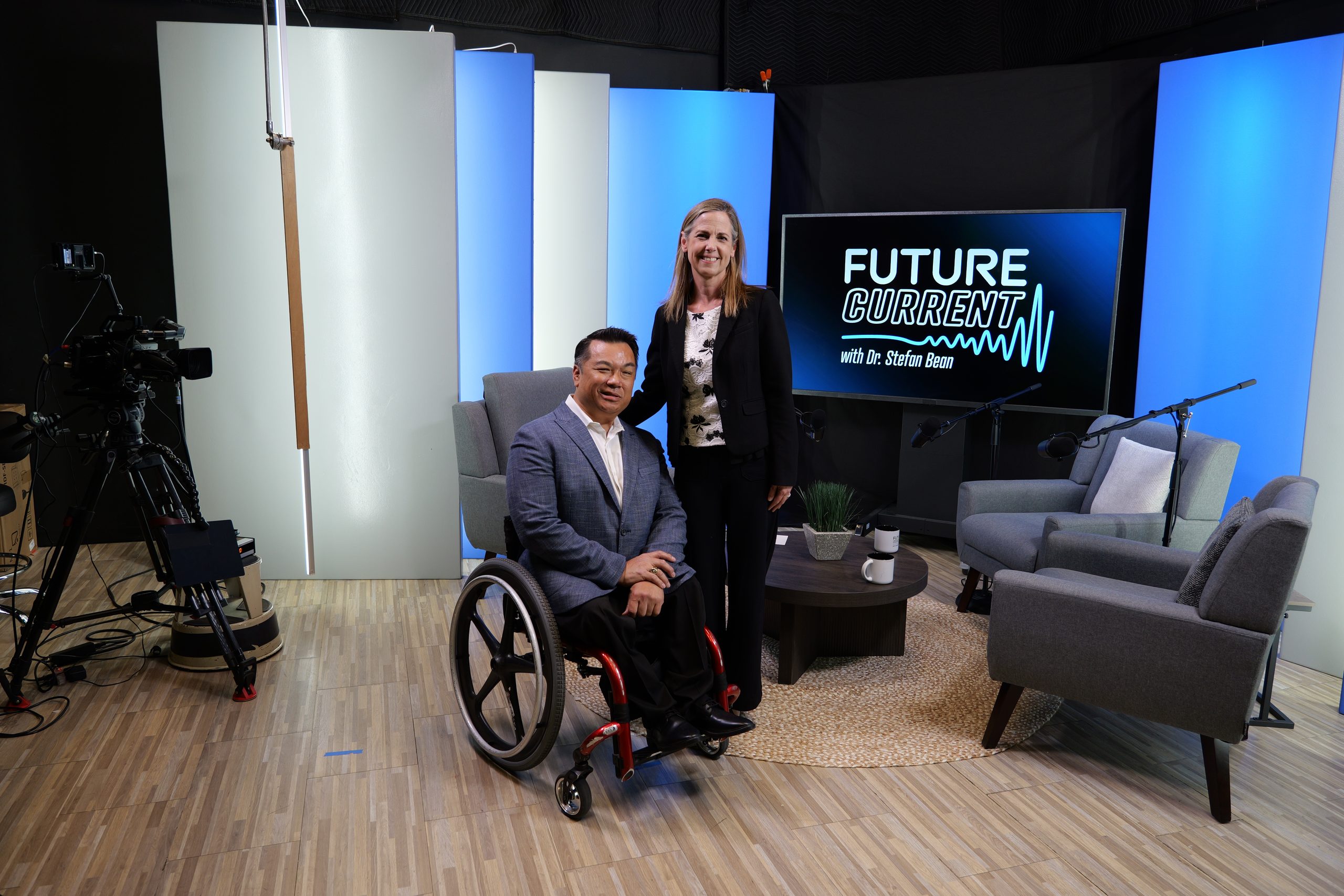
That philosophy is examined in the latest episode of OCDE’s FutureCurrent podcast, where Olmstead joins County Superintendent Dr. Stefan Bean and co-host Lainie Rowell to discuss a statewide effort to rethink how middle and high schools engage students and prepare them for the future.
“Really, at the end of the day, we’re talking about … understanding our students and their families by their name, their faces and their stories,” Olmstead says. “We want to create that sense of belonging on school campuses because belonging creates a sense of engagement.”
Olmstead is an Orange County Department of Education educator currently working with the California Collaborative for Educational Excellence, a statewide agency that helps schools and districts improve student outcomes. In her role, she’s helping lead the expansion of California’s secondary school redesign initiative.
The work, she says, is personal. Olmstead recalls not feeling a sense of belonging when she was a student — an experience that helped inspire her to become an educator.
She remembers telling herself, “I want to be a teacher, so I can make kids like me feel better.”
Secondary redesign
The idea behind secondary redesign is to reshape middle and high schools around students’ needs. Olmstead describes three guiding principles: building meaningful connections with students, providing deeper learning experiences for them, and creating personalized learning structures.
One example she cites is the transition from elementary to middle school. After spending each year with pretty much the same teacher, middle schoolers generally move between multiple teachers, subjects and class periods. Olmstead says that switch can make it harder to build the relationships that support learning.
“Without connection and belonging, it’s hard then for academics to take place,” she says.
Under a redesigned approach, groups of teachers might work with the same students across multiple classes, giving educators more opportunities to collaborate and understand individual needs. Students might also explore subjects through their own interests, work together on projects or demonstrate what they’ve learned in different ways.
The stakes are high, as reflected in student engagement data. A Gallup survey indicates that the share of highly engaged students drops from 74 percent in fifth grade to 32 percent by grade 11.
Olmstead emphasizes that the challenge isn’t a lack of effort from educators, but a school system that hasn’t always been structured to foster meaningful connections and individualized learning.
A statewide effort
Across California, schools and districts are working together to explore new approaches to secondary education. Olmstead says the secondary redesign initiative initially selected 14 groups, or networks, involving approximately 80 districts and 130 schools.
These networks give educators opportunities to share ideas and learn from schools already putting redesign strategies into practice. Visiting those campuses can also help families better understand what these changes might look like for their children.
The conversation also touches on how artificial intelligence is accelerating the need to rethink education. With information increasingly accessible through technology, Olmstead says schools must place greater emphasis on lasting skills such as communication, collaboration, critical thinking and creativity.
Even as technology changes what students need to know, Olmstead’s message returns to something fundamental: Schools must create environments where young people feel known, connected and ready to learn.
FutureCurrent is produced by the Orange County Department of Education and features unscripted conversations with educators, community leaders and changemakers from across Orange County. Episodes are available in audio and video formats on major podcast platforms and YouTube.