
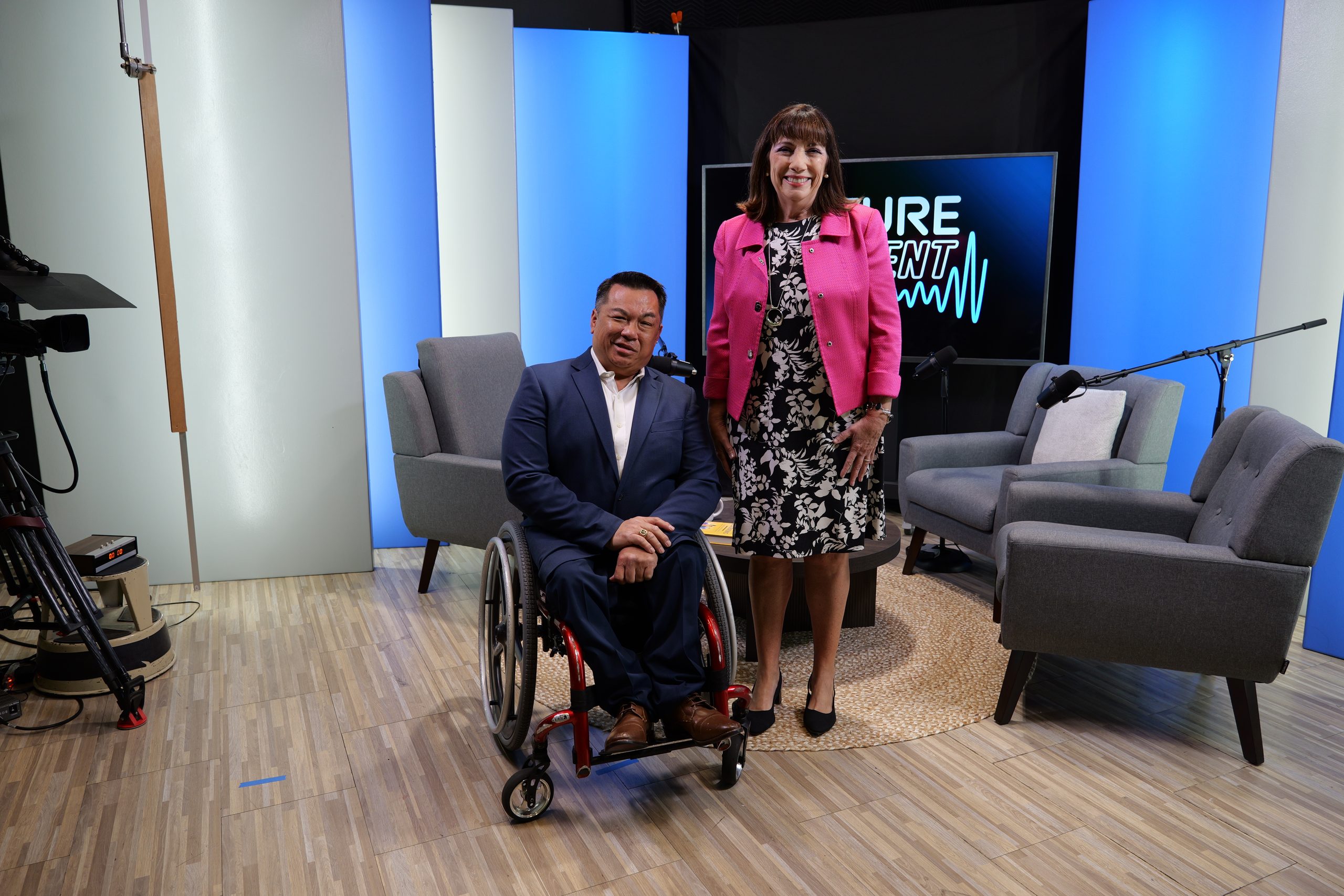
Quick look: Project Tomorrow CEO Julie Evans joins Orange County Superintendent Dr. Stefan Bean on FutureCurrent to share what students are saying about artificial intelligence, self-directed learning and their own futures — and why educators may want to listen.
Students aren’t necessarily waiting for adults to figure out artificial intelligence. They’re already using it to create, explore and learn — often on their own and outside the classroom.
That’s one of the insights Julie Evans brings to the latest episode of OCDE’s FutureCurrent podcast, where the CEO of Orange County-based Project Tomorrow joins County Superintendent Dr. Stefan Bean for a conversation about artificial intelligence, student voice and what young people can teach adults about the future of learning.
Evans has spent decades listening to students, families and educators through Project Tomorrow, a national education nonprofit that works with K-12 schools and districts across the country.
At the heart of that work is a simple idea: Don’t just ask students what they think; actively listen to what they say and use it to inform decisions. That perspective is shaping her view of AI in education.
While schools are rightly devoting considerable attention to policies, guidelines and classroom applications, Evans says students are already exploring AI independently — much as they’ve used other technologies to pursue their own interests outside of school.
Schools and districts, she says, are “thinking about how AI fits into the box of education the way we know it today, while AI on the outside of school is transforming the box.”
That disconnect, she argues, presents an opportunity to rethink not only how schools use AI, but how educators engage students in conversations about it.
The episode goes on to tackle some assumptions surrounding young people and AI, including concerns about cheating. Evans points to research showing that 63 percent of students are concerned they could be falsely accused of using AI to cheat, and she shares what she heard directly from a panel of ninth-graders about how they view learning and assessment.
The discussion also ventures beyond AI, exploring student agency, relationships with teachers and what Evans calls “free-agent learning” — or learning students pursue based on their own interests and curiosity.
Self-directed learning
On that note, Evans pushes back on the notion that young people aren’t interested in learning.
“They are passionate about learning, and they have the world to learn from,” she says.
Technology, says Evans, gives students access to knowledge and resources beyond what may be available through their teachers, schools or communities.
“We have to think differently about the preparation of students and empowering them to be learners on their own,” she says. “Now the students tell us that that’s important to them.”
For schools, Evans says one way to bring that kind of self-directed learning into the classroom is to rethink student choice. Instead of giving students a limited menu — write a paper, make a slideshow or perhaps act something out — educators can give students greater responsibility for deciding how they demonstrate what they’ve learned.
She says that approach starts with something even more fundamental: knowing students well enough to understand their interests, strengths and challenges.
“It starts at a basic level with knowing your students,” Evans says. “It’s about that relationship development.”
Preparing for the unknown
Meanwhile, Evans points to a larger challenge facing educators: No one can say with certainty what the world will look like by the time today’s students graduate from high school or college. That unknown, she says, makes skills that can endure change all the more important. And students themselves appear to recognize that.
“When we ask students, ‘What is the number one skill that you think you need to be successful in the future?’ They say adaptability,” she says.
For Evans, that means being able to learn independently and remain flexible as learning paths change. She counts adaptability alongside critical thinking, problem-solving and communication as “durable skills” that can transcend changes in technology.
Despite the uncertainty surrounding the future, Evans says her conversations with young people leave her encouraged.
“This generation is a very hopeful and optimistic generation,” she says.
FutureCurrent is produced by the Orange County Department of Education and features unscripted conversations with educators, community leaders and changemakers from across Orange County. Episodes are available in audio and video formats on major podcast platforms and YouTube.