
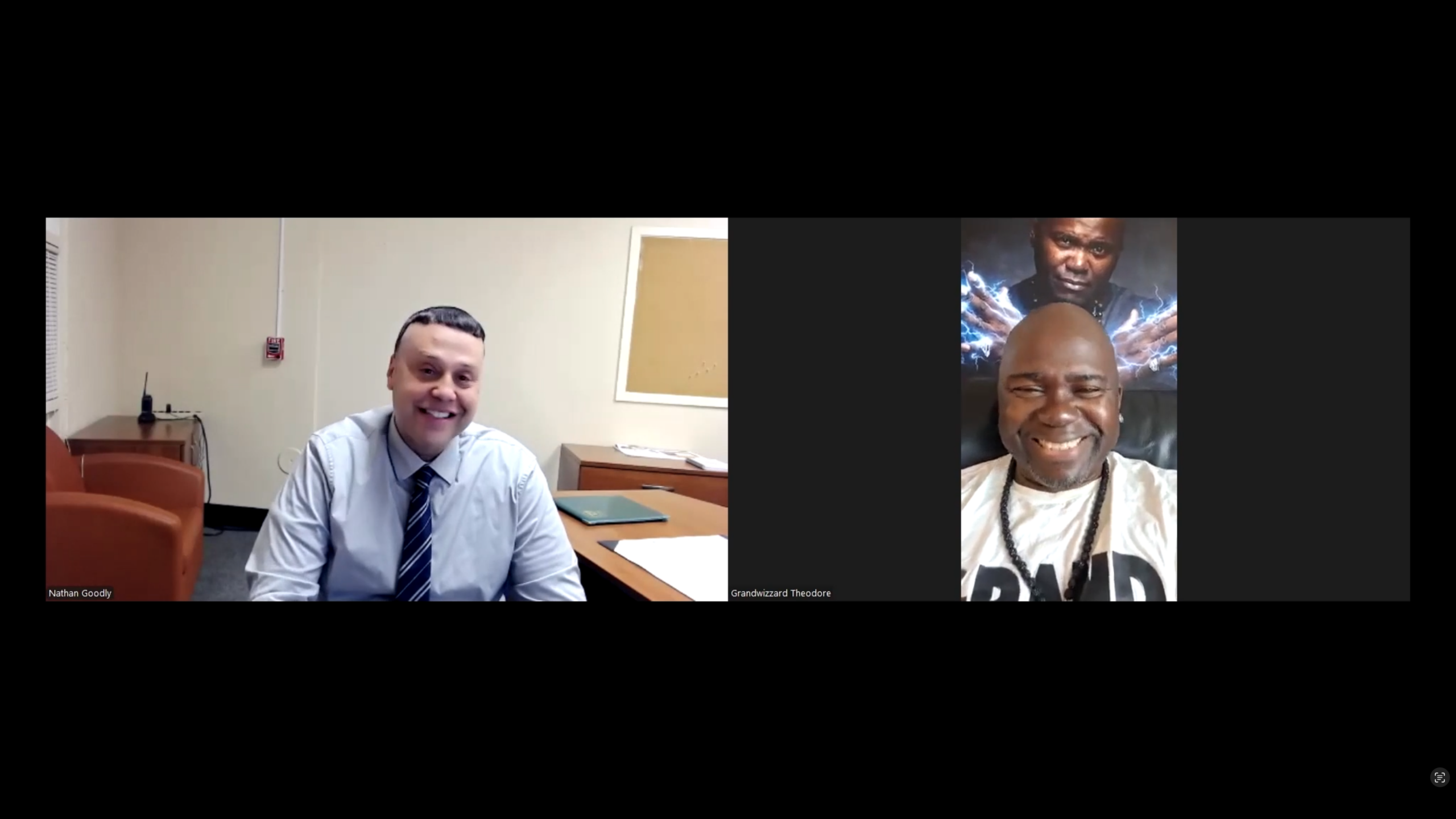
Quick look: Grand Wizzard Theodore shared his journey from an accidental discovery in his Bronx home to becoming a pioneer of hip-hop, encouraging OCDE students to embrace hard work, learning and the belief that anything is possible.
Many people believe that some of the best things in life come unexpectedly, but what they may not know is that the record scratch — one of the most recognizable techniques used by hip-hop DJs — was also one of those happy accidents.
That’s what students from ACCESS Area 4 sites located within the Youth Guidance Center and Orange County Juvenile Hall learned during an interview with legendary hip-hop DJ Grand Wizzard Theodore and OCDE Coordinator Dr. Nathan Goodly. The interview is the third in a series modeled after Careers Without Borders, a former OCDE program in which celebrities and other notable figures shared their paths to success with Goodly and students.
“The goal remains the same: to bring meaningful voices and experiences to our students that inspire them to reach their highest potential,” Goodly said. “I’m very appreciative of the continued support and hope to bring additional guests to our students when possible.”
Theodore discovered the record scratch in 1975 when he was just 12 years old while practicing in his mother’s house in the Bronx. His music was playing a bit too loudly for his mother’s liking, so she unexpectedly “busted into the room” and told him to turn it down.
Startled, Theodore placed his hands on the turntables to silence them, accidentally creating a scratching sound. He immediately recognized the discovery as a gift from God that he could share with the world.
At the time, hip-hop was becoming a powerful art form in New York, which Theodore attributed to the genre “being born from struggle.” For many, it provided a way to express themselves and mentally escape their surroundings.
Origins don’t determine success
But Theodore emphasized to students that where someone comes from does not determine where they can go.
“I want all the kids around the world to realize that it doesn’t matter where you come from,” he said. “You can make a difference in this world. Don’t let anybody tell you it can’t be done, because I’m living proof that it can be done.”
Theodore would go on to play a pivotal role in bringing hip-hop and DJing to the mainstream, alongside artists such as Grandmaster Flash and the Furious Five. His transformation of the turntables into a musical instrument of their own quickly caught on, adding a new element to an already uniquely expressive genre.
In honor of Theodore’s contributions to hip-hop, the Smithsonian briefly featured his Vestax PDX-2000 turntables — cementing his legacy as one of the godfathers of the genre.
While Theodore considers his talent a gift, he also told students that he was able to cultivate it through hard work and a dedication to learning.
“Going to school — do not take that for granted,” he said. “Go to school, learn everything you can possibly learn in school. It may be boring sometimes, it may be exciting sometimes, but that’s part of learning.”
The series will continue Sept. 4, when actor Luis Guzmán is scheduled to join Goodly and students for a similar interview.