
Quick look: Orange County students once again outperformed their state and regional peers on California’s annual assessments, with English language arts scores nearly returning to pre-pandemic levels and similar gains in math and science.
Students across Orange County posted higher scores on state assessments this year, with performance in English language arts nearly returning to pre-pandemic levels and continued gains in mathematics and science.
Results released Thursday, Oct. 9, by the California Department of Education show that students enrolled in Orange County’s 29 districts and 43 charter schools once again exceeded state averages and outpaced neighboring counties in all tested subjects, including English language arts, mathematics and science.
The California Assessment of Student Performance and Progress, or CAASPP, is the statewide system used to measure how well students are mastering academic standards. Administered each spring to nearly 2.9 million students in grades three through eight and 11, CAASPP includes Smarter Balanced online tests in English language arts and math that emphasize critical thinking, problem-solving and written explanations rather than multiple-choice responses.
“California’s significant education investments like Universal Transitional Kindergarten, reading coaches, professional development, and community schools have boosted student proficiency in many areas,” State Superintendent Tony Thurmond said in a press release. “Some growth is modest and some is profound, but in all cases the data reflects the impact of these investments and the hard work of educators to help students succeed.
Bright spots and trends
Orange County’s averages remained higher than those of seven neighboring counties — Los Angeles, Riverside, San Bernardino, San Diego, Santa Barbara, Ventura and Imperial — in both English and math. The difference between Orange County and the next highest-performing county was five percentage points in English language arts and seven points in mathematics, according to county-level comparisons.
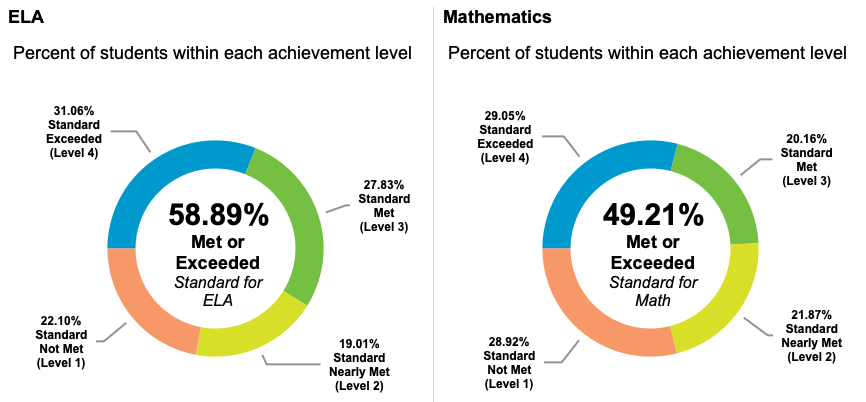
Data also show that the percentage of Orange County students meeting or exceeding standards in English language arts has nearly returned to 2019 levels, coming within 0.59 percentage points of the county’s pre-pandemic rate of 59.5 percent. Mathematics performance continues to trend upward but remains slightly below 2019 benchmarks.
“Orange County’s progress reflects the dedication and tireless efforts of our educators, families and students,” said Orange County Superintendent of Schools Dr. Stefan Bean. “Yet success must reach every child, and that is the moral imperative that drives our work.”
In spring 2025, 59 percent of Orange County students met or exceeded standards in English language arts and 49 percent did so in mathematics. Both figures reflect increases from 2024 and remain above the statewide averages of 49 percent in English and 37 percent in math. In science, 43 percent of local students met or exceeded standards, compared with 33 percent statewide.
According to the California Department of Education, statewide results showed small gains across all subjects, along with continued disparities among student groups.
Progress among student groups
The 2025 data show local improvement among all student groups in both English and math. Foster youth and students experiencing homelessness in Orange County each increased by three percentage points in English language arts, and foster youth recorded a 6-point increase in math.
Among English learners, 53 percent demonstrated moderate or well-developed proficiency in English in 2025, according to results from the English Language Proficiency Assessments for California, or ELPAC. While that figure represents an overall increase from last year, the data show a decline among elementary grade levels, with the exception of kindergarten, where scores improved.
Although performance improved across all groups, disparities continue to highlight where additional resources and targeted interventions are needed. Fewer than one-third of foster youth, English learners, students experiencing homelessness and students with disabilities met or exceeded standards in English or math.
Among long-term English learners, less than 4 percent met or exceeded the standard in mathematics, surpassing last year’s rate by about 43 percent.
OCDE’s strategic roadmap
The Orange County Department of Education uses assessment data to guide support for districts and schools. This year, the department’s efforts are tied to its 5-3-1 Strategic Plan, which focuses on strengthening instructional practices, promoting data-informed decision-making and ensuring access to educational opportunities for all students.
“Instruction and literacy are central to OCDE’s 5-3-1 Strategic Plan, which has really come to life over the past year,” Dr. Bean said. “Through this roadmap, we’re expanding career technical education, launching new innovation initiatives and advancing key efforts to amplify best practices across the county.”
“Along with these initiatives, we’re working to uplift schools and students by offering our district partners new opportunities for training, technical assistance and collaboration designed to support every learner,” Bean said. “As these efforts take root, we expect to see continued gains in student achievement — but our goal reaches beyond test scores. It’s about giving every student in every community the opportunity to succeed in school and in life.”
For more information about the California Assessment of Student Performance and Progress System, visit the California Department of Education’s website. To find scores for individual schools and districts, visit caaspp-elpac.ets.org.